

For millennia, oceans, great lakes, rivers and ponds symbolized wilderness and inexhaustibility of resources.
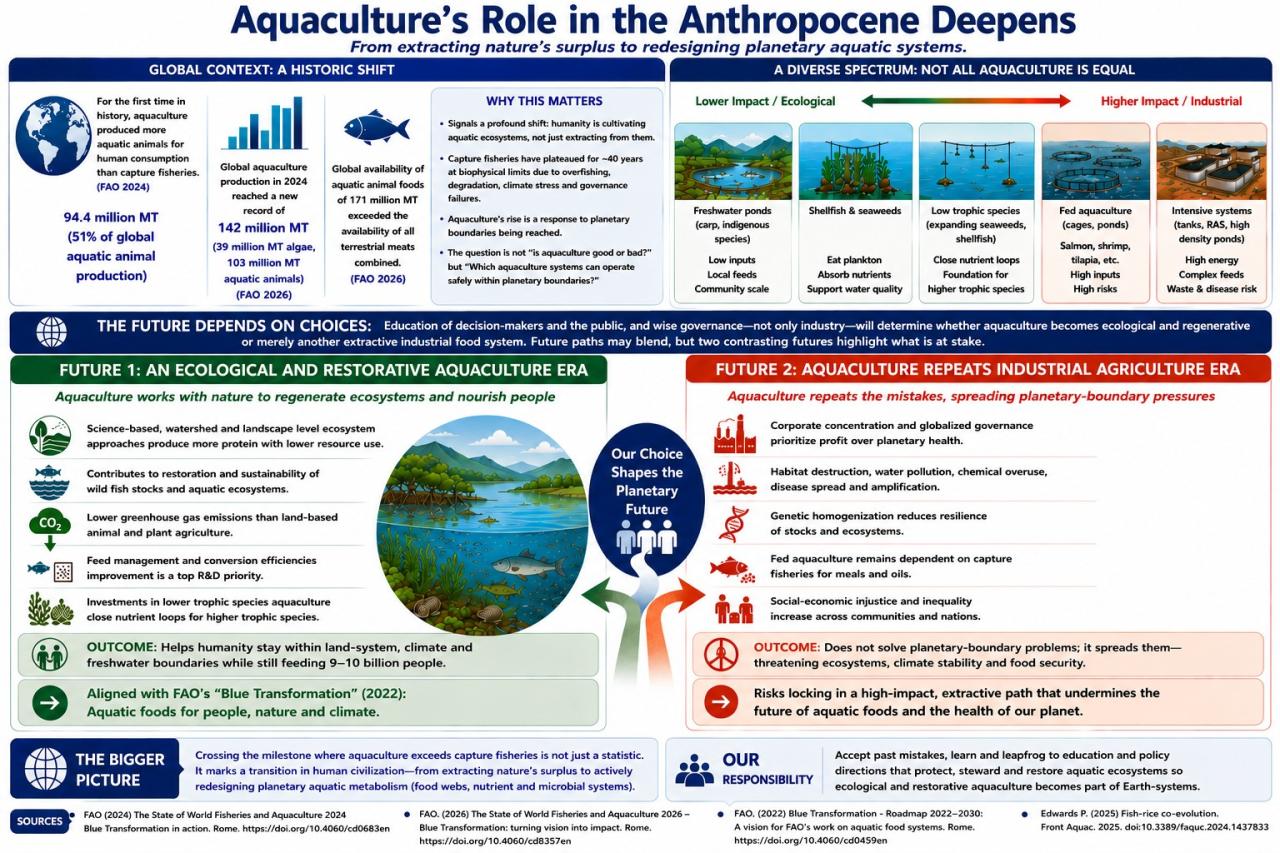
FAO (2024) reported that, for the first time in history, aquaculture produced more aquatic animals for human consumption than capture fisheries, 94.4 million metric tons (MMT), or 51% of global aquatic animal production. FAO (2026) reported that global aquaculture production in 2024 reached a new production record of 142 million MT (39 million MT algae, 103 million MT aquatic animals), and that the global availability of aquatic animal foods of 171 million MT exceeded the availability of all terrestrial meats combined.
These achievements are some of the most important but underappreciated transitions in human food systems since the dawn of agriculture and the domestication of livestock. Their importance goes far beyond statistics. They signal a profound shift in the relationship between humans and the biosphere.
Imagine if humanity still depended on hunting wild mammals for protein. We would have exhausted terrestrial wildlife long ago. Instead, crops, cattle, chickens, pigs, etc. became dominant because wild ecosystems could not support billions of humans. Now the same transition is occurring in aquatic systems. For most of human history humans were aquatic hunter-gatherers, apart from China which was densely populated in antiquity and aquaculture evolved over a thousand years ago (Edwards 2025). Aquatic foods came from hunting wild marine and freshwater ecosystems and gathering fish, shellfish, and seaweeds. A new phase of global aquatic food production has begun on a planetary scale. Humanity is cultivating the planet’s aquatic ecosystems rather than simply extracting from them. Oceans, Great Lakes and rivers are now fully coupled to the future of farming in human civilization.
An especially important planetary signal that cannot be ignored any longer is that wild fisheries have reached biophysical limits. Global capture fisheries production has not increased for almost 40 years due to overfishing, illegal takings, ecosystem degradation, climate stress, and governance failures. Aquaculture’s rise is therefore a response to that planetary boundary being reached. In addition, there are few relatively intact aquatic ecosystems, mostly in Africa and South America.
Humanity now manages almost all of Earth as a cultivated planet. Planetary boundaries are not an abstract theory but are reshaping global food systems. Aquatic food security depends on our ability to direct aquaculture’s rise and to protect, steward and recover aquatic ecosystems and learn how to govern them wisely.
For humanity, the question about aquaculture is not, is it good or bad? But rather, which aquaculture systems can operate safely within planetary boundaries?
Not all aquaculture is equal. This is probably the single biggest misunderstanding in public discussions as aquaculture is more diverse than agriculture. Low impact carp and indigenous species in freshwater ponds, marine shellfish and seaweeds on ropes eating plankton and absorbing nutrients, and high impact intensive salmon, shrimp and tilapia in cages, tanks, and ponds are as different aquaculture ecosystems as agroecosystems of lettuce and broccoli farming and cattle/chicken feedlots.
The future of aquaculture and the restoration of aquatic ecosystems and their contributions to planetary health and global food security without even more deterioration depends largely on whether aquaculture becomes ecological and regenerative, or merely another extractive industrial food system. Will aquaculture reduce pressure on planetary boundaries? It could, but only if greater education of decision-makers, the public and their governance systems – not only industry – choose ecological and regenerative futures.
Possible futures could be starkly different and may blend and diversify, but some aspects are plainly different.
Future 1: An Ecological and Restorative Aquaculture Era. In this scenario, science-based, watershed and landscape level ecosystem approaches to aquaculture produce more protein with lower resource use and become the aquaculture development priority; aquaculture development contributes to the restoration and sustainability of wild fish stocks; aquaculture is documented scientifcally to have lower greenhouse gas emissions than land-based animal and plant agriculture; feed management and conversion efficiencies improvements are a top global R&D priority; and accelerated investments and stratgeic subsidies in the expansion of lower trophic species aquaculture closes nutrient loops for higher trophic species.
Aquatic foods therefore help humanity stay within land-system, climate and freshwater boundaries while still feeding 9–10 billion people. FAO (2022) frames this as the “Blue Transformation.”
Future 2: Aquaculture Repeats Industrial Agriculture Era. In this scenario aquaculture reproduces the mistakes of industrial agriculture of corporate concentration, coastal, lake, wetland and other habitat destruction, increased water pollution, chemical overuse, disease spread and amplification, uncontrolled genetic homogenization, and adds to social-economic injustice and inequality. Globalized aquaculture remains the dominant development governance system. Fed aquaculture tarries on dependent on capture fisheries for meals and oils.
In this scenario aquaculture does not solve planetary-boundary problems; it adds to and spreads them.
The emergence of an ecological and regenerative aquaculture for our sacred planet (Morther Ocean/Mother Earth) would reveal that humanity has grown to accept its mistakes; not recreate the aquaculture wheel of the uneducted past, but leapfrog to advancing education and policy directions that no longer merely take surplus productivity from Nature but redesign planetary aquatic structures and functions (food webs, nutrient and microbial systems) that incorporate ecological and restorative aquaculture as the priority and a vital part of the Earth's aquatic systems.
Culture exceeding capture fisheries is not just a statistic. It is evidence that humanity has crossed from an era of extracting nature’s surplus into an era of actively redesigning planetary metabolism.
Aquaculture’s role in the Anthropocene deepens.
References
Edwards P. (2025) Fish-rice co-evolution. Front Aquac. 2025. https://www.doi.org/10.3389/faquc.2024.1437833
FAO. (2022) Blue Transformation - Roadmap 2022–2030: A vision for FAO’s work on aquatic food systems. Rome. https://doi.org/10.4060/cc0459en
FAO (2024) The State of World Fisheries and Aquaculture 2024 – Blue Transformation in action. Rome. https://doi.org/10.4060/cd0683en
FAO. (2026) The State of World Fisheries and Aquaculture 2026 – Blue Transformation: turning vision into impact. Rome. https://doi.org/10.4060/cd8357en
